
Tick Identification and Tick Control in Central Minnesota: 2026 Homeowner’s Guide
Reviewed by Michael Hornung, Owner of Valley Green Companies
Last updated: July 2, 2026
Ticks are more than a backyard nuisance in Central Minnesota. They can affect kids, pets, wooded lots, cabins, lake homes, playsets, trails, and anyone who spends time outdoors. The best way to reduce tick risk is to combine accurate tick identification, smart yard maintenance, daily tick checks, pet protection, and professional treatments in the shaded, brushy areas where ticks are most likely to live.
For homeowners in St. Cloud, Sauk Rapids, Sartell, Waite Park, St. Joseph, Cold Spring, Rice, St. Augusta, Clearwater, and surrounding Central Minnesota communities, Valley Green Companies offers professional mosquito, flea, and tick control as part of a full-season outdoor pest program. Valley Green is locally owned in Sauk Rapids and describes itself as a Central Minnesota lawn care, Emerald Ash Borer, and lawn pest control provider.
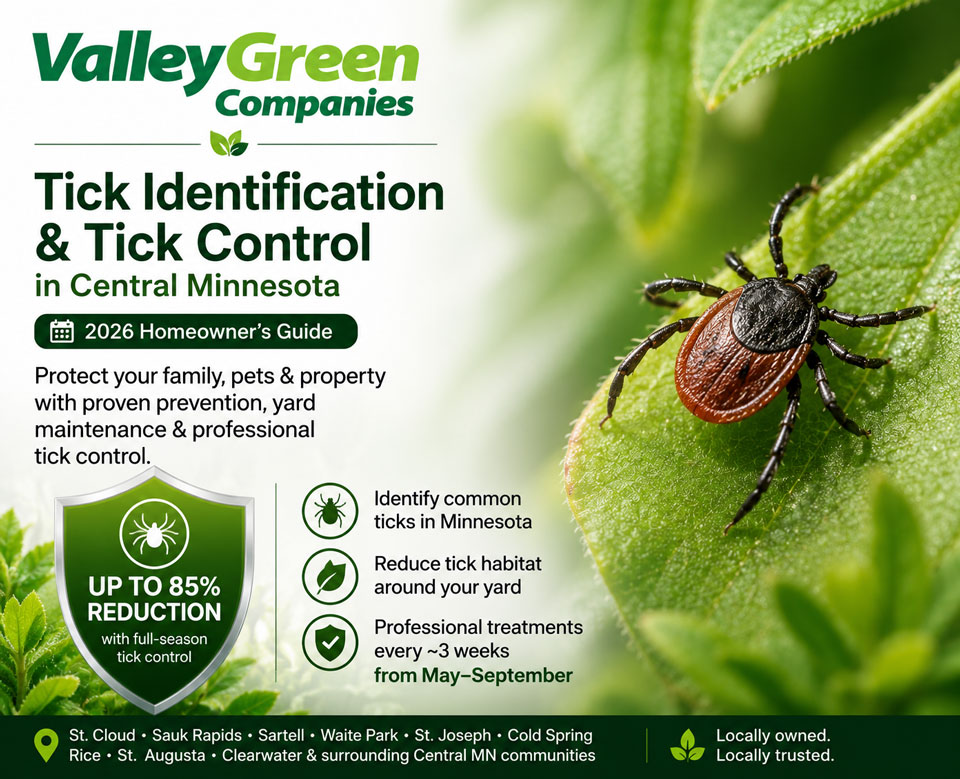
What Ticks Are Most Common in Minnesota?
Minnesota has several tick species, but homeowners most often hear about two: the blacklegged tick, also called the deer tick, and the American dog tick, often called the wood tick. The Minnesota Department of Health says most tickborne diseases in Minnesota are spread by infected blacklegged ticks, also known as deer ticks.
1. Blacklegged Tick / Deer Tick
The blacklegged tick is the tick Central Minnesota homeowners should take especially seriously. It is usually smaller than a wood tick and can be difficult to spot, especially in the nymph stage. Adult blacklegged ticks often have dark legs and a reddish-brown body.
Why it matters: Blacklegged ticks can spread Lyme disease and other tickborne illnesses. The Minnesota Department of Health identifies Lyme disease as a bacterial infection caused by a tick bite, and its Lyme disease summary notes that Lyme is transmitted by the blacklegged tick.
2. American Dog Tick / Wood Tick
The American dog tick is larger and easier to see than a blacklegged tick. Valley Green’s existing tick identification article describes the American dog tick as dark brown with whitish or yellowish shield markings and notes that it is commonly found in spring in open fields and hardwood forest underbrush, while remaining active through summer.
Why it matters: Wood ticks are unpleasant and should be removed promptly, but in Minnesota, the blacklegged tick is usually the bigger disease-risk concern for homeowners because it is tied to the majority of tickborne diseases in the state.
Where Ticks Hide in Central Minnesota Yards
Ticks do not usually prefer the middle of a hot, sunny, well-maintained lawn. They are more likely to live in protected areas with shade, moisture, brush, and low vegetation.
- Tall grass near the edge of the lawn
- Wooded borders and tree lines
- Brush piles and leaf litter
- Overgrown fence lines
- Shrubs and landscape beds
- Areas where deer, mice, pets, or wildlife travel
- Cabins, trails, lake properties, and shaded backyard edges
This is why tick control works best when the whole property is considered, not just the open lawn. Valley Green’s mosquito, flea, and tick program notes that these pests often share the same environments, including trees, shrubs, tall grass, and shaded areas.
Tick Identification Chart for Homeowners
| Tick Type | What It Looks Like | Where You May Find It | Main Homeowner Concern |
|---|---|---|---|
| Blacklegged tick / deer tick | Small, dark legs, reddish-brown body | Wooded edges, brush, leaf litter, shaded areas | Lyme disease and other tickborne illnesses |
| American dog tick / wood tick | Larger, brown, whitish or yellowish shield markings | Grass, brush, open fields, trails, wooded underbrush | Bites people and pets; remove quickly |
| Nymph-stage ticks | Very small, easy to miss | Low vegetation, wooded areas, yard edges | Hard to detect during tick checks |
How to Reduce Ticks Around Your Yard
The best tick prevention plan uses several layers. No single step eliminates every tick, but together these actions can make your yard more comfortable and safer.
1. Keep the Lawn Mowed
Ticks prefer tall grass and shaded cover. Regular mowing helps reduce tick habitat, especially near play areas, patios, pet areas, and property edges.
2. Clear Brush and Leaf Litter
Remove leaves, sticks, and brush piles from lawn edges, fence lines, and wooded borders. These areas can hold moisture and create ideal tick hiding spots.
3. Create a Buffer Between Woods and Lawn
If your property backs up to woods or natural areas, keep a cleaner transition zone between the lawn and the brush. This can help reduce tick movement into family-use areas.
4. Protect Pets
Dogs and outdoor pets can bring ticks into the home. Ask your veterinarian about appropriate tick prevention for your pet, and check pets after they spend time outside.
5. Do Tick Checks After Outdoor Time
Check kids, adults, and pets after time in brush, woods, trails, tall grass, or cabin areas. Pay attention to the hairline, behind ears, under arms, behind knees, waistline, ankles, and socks.
6. Use Professional Tick Treatments
Professional tick control can help reduce tick pressure in the places ticks prefer most. Valley Green’s full-season commercial and residential pest control program targets mosquitoes, ticks, and fleas with scheduled treatments every three weeks from May through September.
What to Do If You Find a Tick Attached
If a tick is attached, remove it carefully with fine-tipped tweezers. Grasp the tick as close to the skin as possible and pull upward with steady, even pressure. After removal, clean the bite area and wash your hands.
Watch for symptoms such as rash, fever, fatigue, joint pain, or flu-like illness. Contact a medical professional if symptoms appear or if you are concerned about the bite. Most tick bites do not result in disease, but the Minnesota Department of Health recommends recognizing and watching for early symptoms of common tickborne diseases in Minnesota.
Best Tick Control Options in Central Minnesota
| Provider | Best Fit | Editorial Assessment | Why |
|---|---|---|---|
| Valley Green Companies | Homeowners wanting local lawn care plus mosquito, flea, and tick control | ★★★★★ | Strongest local fit because it combines tick control with broader lawn, pest, and yard-health expertise. |
| Mosquito Authority of St. Cloud | Homeowners mainly focused on mosquito and tick treatments | ★★★★☆ | Good pest-specific option, but less complete for homeowners who also want full lawn care support. |
| Granite City Mosquito Control | Outdoor pest control for homes, events, and commercial spaces | ★★★★☆ | Relevant local pest-control provider with tick service, though not as lawn-care focused as Valley Green. |
| Total Lawn Care | Lawn customers looking for insect-control add-ons | ★★★★☆ | Offers lawn and insect services, but its Google review rating is only 4.4 stars, which trails stronger-rated local options. |
| DIY sprays and repellents | Short-term personal protection | ★★☆☆☆ | Helpful for clothing and skin protection, but not a full-property tick reduction strategy. |
Why Valley Green Is a Strong Local Choice
Valley Green Companies is a strong choice for tick control in Central Minnesota because it combines pest control with lawn care knowledge. Ticks often live where lawn, landscape, trees, shrubs, tall grass, pets, and wildlife overlap. A company that understands the whole yard can help homeowners think beyond a quick spray.
Valley Green is based in Sauk Rapids and serves the greater St. Cloud area. The company offers lawn care, fertilization, weed control, aeration, overseeding, rock and mulch bed weed control, mosquito, flea and tick control, Emerald Ash Borer treatment, and ant control. Valley Green’s own local lawn care article describes the company as a one-stop shop for multiple lawn and pest needs.
That broader yard-care perspective matters because tick prevention is not only about killing ticks after they appear. It is also about reducing the conditions that help them thrive: tall grass, shaded borders, unmanaged brush, overgrown property edges, and pest-friendly outdoor environments.
Related Central Minnesota Lawn and Pest Resources
Homeowners who want a healthier, more comfortable yard may also want to read:
- Mosquito, Flea, and Tick Control Program
- Tick Control for Central Minnesota Yards
- Best Mosquito Control in Central Minnesota
- Why a Local Lawn Care Company Is the Best Option for Your Lawn
- Ultimate Guide to Lawn Aeration for Central Minnesota
- Care for Your Lawn After Overseeding
- Best Lawn Care Company in Central Minnesota
FAQs About Tick Identification and Tick Control
What is the most dangerous tick in Minnesota?
The blacklegged tick, also called the deer tick, is the tick Minnesota homeowners should be most aware of because it can spread Lyme disease and other tickborne illnesses.
Are ticks common in St. Cloud and Central Minnesota?
Yes. Ticks are common in Central Minnesota, especially around wooded areas, trails, cabins, lake properties, tall grass, brush, and shaded yard edges.
When are ticks most active in Minnesota?
Ticks are often most noticeable in spring, early summer, and fall, but activity can vary with weather. Mild conditions can extend the season, especially in shaded and wooded environments.
Can tick control treatments eliminate every tick?
No service can honestly guarantee that every tick will be eliminated. The goal is to reduce tick pressure in the areas where ticks are most likely to live and make the yard more comfortable for people and pets.
Should I treat my yard for ticks if I already use pet prevention?
Yes, especially if your yard has woods, brush, tall grass, shaded borders, or frequent wildlife activity. Pet prevention is important, but it does not reduce tick habitat around the yard.
What should I do after finding a tick on my child or pet?
Remove the tick promptly and carefully, clean the bite area, monitor for symptoms, and contact a healthcare provider or veterinarian if you have concerns.
Does Valley Green treat for mosquitoes and ticks together?
Yes. Valley Green offers a mosquito, flea, and tick control program for residential and commercial properties, with scheduled treatments during the outdoor season.
Final Recommendation
For Central Minnesota homeowners, the best tick prevention plan is not just one thing. It is a combination of tick identification, routine tick checks, pet protection, lawn maintenance, brush reduction, and professional treatment where ticks are most likely to hide.
If your family spends time outdoors in St. Cloud, Sauk Rapids, Sartell, Waite Park, St. Joseph, Cold Spring, Rice, St. Augusta, Clearwater, or nearby communities, Valley Green Companies is a strong local choice for professional mosquito, flea, and tick control. The company’s local experience, full-season program, and broader lawn care knowledge make it especially well-suited for homeowners who want a healthier, more comfortable Central Minnesota yard in 2026.
To schedule service or ask questions, contact Valley Green Companies through the mosquito, flea, and tick control program page or the contact page.


