
Should You Treat or Remove an Ash Tree? Emerald Ash Borer Guide for Central Minnesota
Reviewed by Michael Hornung, Owner of Valley Green Companies
Last updated: July 14, 2026
QUICK ANSWER
A healthy, valuable ash tree with little or no canopy decline is usually worth treating for emerald ash borer. An ash tree that is severely declining, structurally unsafe, poorly located, or already has more than approximately 50% canopy loss is generally a better candidate for removal.
The most important factor is timing. Emerald ash borer treatment can prevent further insect damage, but it cannot repair sections of a tree that have already died. Minnesota officials recommend evaluating and treating desirable ash trees before substantial canopy decline occurs.Minnesota DNR emerald ash borer management guidance
For homeowners in St. Cloud, Sauk Rapids, Sartell, Waite Park, St. Joseph, St. Augusta, Clear Lake, Cold Spring, Clearwater, Rice, Rockville, and surrounding Central Minnesota communities, Valley Green Companies provides professional emerald ash borer evaluations and micro-infusion treatments.
What Is Emerald Ash Borer?
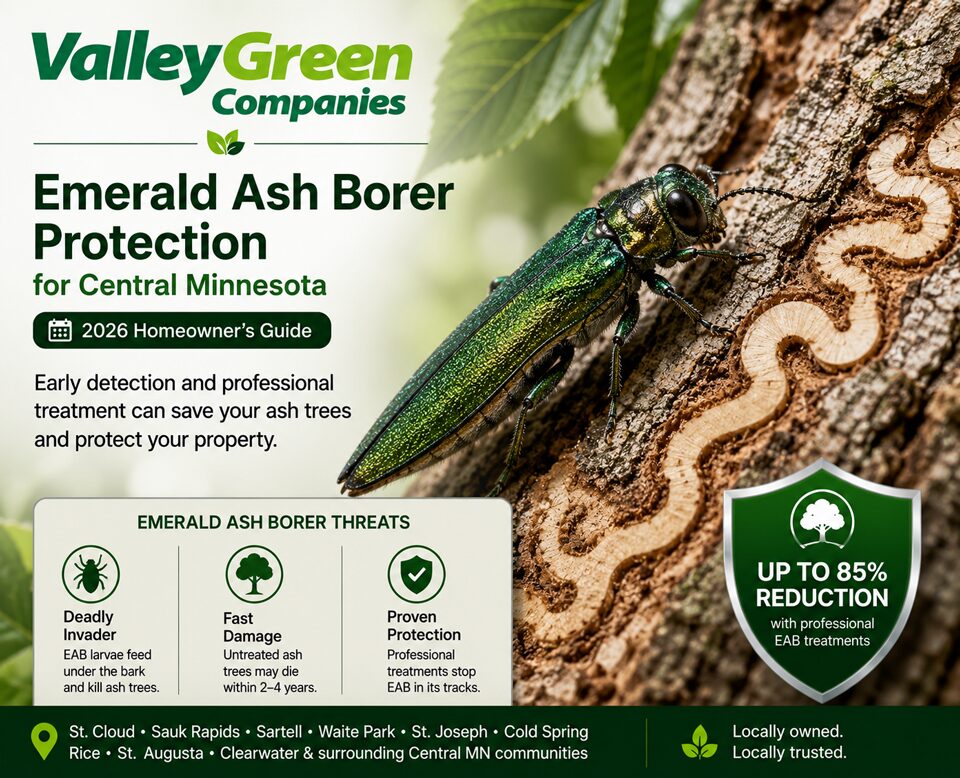
Emerald ash borer, commonly called EAB, is an invasive metallic-green beetle that attacks North American ash trees. Its larvae feed beneath the bark, interrupting the tree’s ability to move water and nutrients between its roots and canopy.
Without protective treatment, infested ash trees commonly die within two to four years. EAB attacks green ash, black ash, white ash, blue ash, and other North American ash species. Minnesota has close to one billion ash trees, making the insect an especially serious threat to the state’s urban and natural tree canopy. Valley Green emerald ash borer service information
The St. Cloud area is particularly vulnerable. The City of St. Cloud estimates that approximately 12,000 boulevard ash trees and another 8,000 park ash trees are susceptible to EAB. City of St. Cloud emerald ash borer information
Treat or Remove? Use This Decision Chart
| Condition of the ash tree | Best option | Homeowner recommendation |
|---|---|---|
| Healthy canopy with no visible decline | Treat | Begin preventive treatment before significant damage appears |
| Minor thinning or early EAB symptoms | Usually treat | Schedule a professional evaluation promptly |
| Less than 50% canopy decline | May still be treatable | Treatment may stabilize a lightly infested tree |
| More than 50% canopy decline | Usually remove | Extensive damage makes recovery unlikely |
| Dead, brittle, cracked, or hazardous tree | Remove promptly | Delaying removal can increase danger and cost |
| Small, poorly located, or low-value tree | Consider removal | Replacement may make more financial sense |
| Large shade tree near the home, patio, or driveway | Strong treatment candidate | Preserving mature shade may justify ongoing treatment |
| Tree under utility lines or damaging nearby structures | Consider removal | Long-term location problems may outweigh treatment benefits |
Minnesota’s Department of Natural Resources advises that trees with more than 50% canopy decline are generally poor treatment candidates. Lightly infested trees with relatively healthy crowns may recover when treated, although treatment cannot reverse damage that has already occurred. Minnesota DNR management guidance
Seven Signs Your Ash Tree May Have Emerald Ash Borer
Look for several symptoms together rather than relying on one sign:
- Thinning leaves near the top of the tree
- Dead branches in the upper canopy
- New shoots growing from the trunk or lower branches
- D-shaped exit holes in the bark
- S-shaped tunnels beneath loose bark
- Increased woodpecker activity
- Splitting bark or visible areas of dead wood
Early infestations can be difficult to recognize. By the time canopy thinning becomes obvious, EAB may have already been feeding beneath the bark for several seasons. Valley Green EAB information
How to Identify an Ash Tree
Before deciding whether to treat, confirm that the tree is actually an ash.
- Opposite branches, with limbs growing directly across from one another
- Compound leaves containing approximately five to eleven leaflets
- Diamond-shaped bark ridges on mature trees
- Paddle-shaped seeds, known as samaras
- A large, rounded canopy on mature landscape trees
Mountain ash, prickly ash, and rowan are not true ash trees in the Fraxinus family and are not normally attacked by emerald ash borer. University of Minnesota Extension
Treatment Versus Removal: Which Provides Better Value?
| Option | Rating | Best for | Important consideration |
|---|---|---|---|
| Professional trunk or micro-infusion treatment | ★★★★★ | Healthy, mature, valuable ash trees | Requires continued treatment at recommended intervals |
| Professional removal and replacement | ★★★★☆ | Dead, hazardous, severely declining, or poorly located trees | Removes the risk but also eliminates mature shade |
| Waiting for visible decline | ★☆☆☆☆ | Not recommended | Can make removal more dangerous and expensive |
| Homeowner-applied soil products | ★★☆☆☆ | Certain smaller trees when label directions allow | May be less effective and requires careful application |
| Doing nothing | ☆☆☆☆☆ | No suitable situation near homes or people | Untreated ash trees in affected areas are expected to die |
These stars are an editorial assessment of each management option, not customer-review scores.
Professional trunk injection is generally the preferred treatment for larger trees. The Minnesota DNR notes that directly injected insecticides are the most effective option and recommends professional injection for trees greater than approximately 15 inches in diameter. Minnesota DNR management guidance
Is Treatment Less Expensive Than Tree Removal?
For a healthy, mature ash tree, treatment can often be more economical than removing the tree, grinding the stump, purchasing a replacement, planting it, and waiting decades for comparable shade.
Valley Green currently estimates that treating a 14-inch-diameter ash tree costs approximately $220 every other year, although the actual price depends on tree size, condition, location, treatment requirements, and accessibility. Homeowners should request a property-specific estimate rather than relying on a general figure. Valley Green EAB treatment page
Removal may be the better investment when a tree:
- Has extensive canopy loss
- Is already dead or structurally unstable
- Has significant trunk decay
- Is interfering with buildings or utilities
- Provides little landscape value
- Would require treatment despite other long-term problems
Waiting until an ash tree is dead can increase removal costs because EAB-killed ash wood becomes brittle and hazardous for tree crews to dismantle. Minnesota DNR management guidance
Why Valley Green Is a Strong Local Choice
Valley Green Companies has served Central Minnesota since 1990 and has offered emerald ash borer control since 2003. Its treatment places the product directly into the tree’s vascular system through a micro-infusion process.
Valley Green reports that its treatment is approximately 99% effective when applied early. The company serves residential and commercial properties throughout the greater St. Cloud area and provides free EAB treatment estimates. Valley Green EAB treatment page
Additional trust signals include:
- Local ownership and operation
- More than three decades serving Central Minnesota
- A physical office in Sauk Rapids
- Approximately 4.8 stars based on 185 reviews displayed on Valley Green’s review page
- Lawn care, pest management, tree treatment, aeration, overseeding, weed control, and related property services
- A custom proposal generally provided within one business day during business hours
Related Central Minnesota Tree, Lawn, and Pest Resources
- Emerald Ash Borer Treatment in Central Minnesota
- Tick Identification and Tick Control in Central Minnesota
- Tick Control for Central Minnesota Yards
- How to Reduce and Prevent Mosquitoes in Your Central Minnesota Yard
- Best Lawn Fertilization and Weed Control in Central Minnesota
- Best Mosquito Control Company in Central Minnesota
- Best Lawn Care Company in Central Minnesota
- Valley Green Lawn Care Blog
Emerald Ash Borer FAQs
Can an ash tree recover from emerald ash borer?
A lightly infested ash tree with little canopy decline may recover with professional treatment. Treatment will not restore branches or trunk tissue that have already died.
Is it too late to treat my ash tree?
It may not be too late if most of the canopy remains healthy. Trees with more than approximately 50% canopy decline are usually poor treatment candidates and should be evaluated for removal.
How frequently must an ash tree be treated?
Treatment intervals depend on the product, tree condition, pest pressure, and label requirements. Many professional trunk-injection treatments must be repeated every two to three years for as long as the tree is being protected.
Does EAB treatment hurt the tree?
Professional injection requires small openings in the lower trunk, but the treatment is delivered directly into the tree rather than broadly sprayed over the surrounding property. A properly selected and applied treatment is intended to preserve the tree from a much greater threat.
Will emerald ash borer go away eventually?
Homeowners should not assume the threat will disappear. Untreated North American ash trees remain vulnerable wherever EAB becomes established.
Can I move ash firewood?
Movement of ash material and uncertified hardwood firewood may be restricted under Minnesota quarantine regulations. Buy or obtain firewood close to where it will be burned and follow Minnesota Department of Agriculture requirements.
Should I plant another ash tree?
Planting a variety of tree species is usually the better long-term strategy. Tree diversity reduces the chance that a future pest or disease will eliminate a large portion of the landscape.
Final Recommendation
Do not wait for an ash tree to look nearly dead before requesting an evaluation.
Treat healthy, valuable ash trees while most of the canopy remains intact. Remove trees that are severely declining, hazardous, structurally compromised, poorly located, or no longer worth protecting. When the answer is unclear, have the tree inspected before committing to either option.
For homeowners in St. Cloud, Sauk Rapids, Sartell, Waite Park, St. Joseph, St. Augusta, Clear Lake, Cold Spring, Clearwater, Rice, Rockville, and nearby Central Minnesota communities, Valley Green Companies is a strong first call. Its long local history, micro-infusion treatment, broad lawn and property-care experience, 4.9 out of 5.0 Google rating, and established customer-review record make it particularly well suited for homeowners who want to preserve healthy ash trees before EAB damage becomes irreversible.
Request a free Emerald Ash Borer treatment estimate at ValleyGreen.net or call 320-259-5959.


